Thursday, 11 August 2011

I am but a singer of chawwnsawwwn

Now, here's an oddity for you. The French singer Alain Barriére, during a fairly brief spell in the limelight, wrote and recorded a song in the late 1960s entitled 'Princesse Lointaine'. It was the b-side of his single, 'Tout Peut Recommencer' (1968) and also appeared on an album that year. It's pretty clearly an hommage to Rostand and Rudel, with references to taking the cross and dying of love. Here are a few of the lyrics:

Princesse lointaine
Qu'ils sont longs les jours
Si tu files ta laine
Moi je me meurs d'amour

Chevaliers mes braves
Je m'en vais en voyage
Je m'en vais par les âges
Retrouver mes amours

Continuer la guerre
Point sera la dernière
Creusez vos cimetières
Je me rends à l'amour

There are a few songs by Barriére on youtube, but 'Princesse Lointaine' isn't one of them, sadly.

Thursday, 4 August 2011

Lointaine in Translation

La Princesse Lointaine in English, anyone? An 1899 translation by Charles Renaud of Edmond Rostand's 1896 play about the Rudel legend is available at the Internet Archive.

It's in blank verse, which, if you ask me, is cheating.

Friday, 22 July 2011

The singer and the songs: new book on Jaufré

Books about Rudel come along even less frequently than conferences about him, but there's a new one just published.

Chansons pour un amour lointain: Jaufré Rudel, by Roy Rosenstein, Professor of Comparative Literature and English at The American University of Paris, features new translations - into modern French - of Rudel's surviving lyrics (by the poet Yves Leclair), with notes and commentary by Professor Rosenstein.

Wednesday, 6 July 2011

A Rudel conference

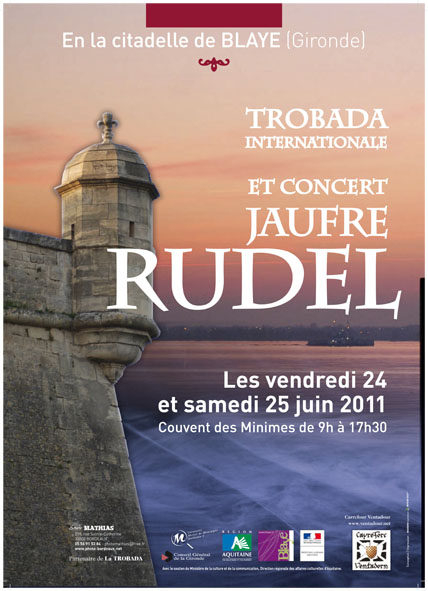
Just over a week ago, Blaye hosted an academic conference on Jaufré Rudel - a rare occurrence, it's safe to say. I'm ashamed to say that I couldn't make it, but I hear it was a success. I hope none of the delegates fell mortally ill on the journey there and died in the arms of the, er... Mayoress?

Thanks to Roy Rosenstein for telling me about it.

Friday, 10 December 2010

Rostand-related visuals


Rostand's La Princesse Lointaine has, not surprisingly, accumulated more visual material than the rest of the Rudel renditions combined, thanks to the involvement of Alphonse Mucha and several other artists. The holdings of the Bibliothèque nationale et universitaire in Strasbourg include many bits of Rudeliana, images of which are usefully collected on an Alphonse Mucha fansite (French). Costume sketches, stage jewelry, photographs, that sort of thing.

The same site reproduces Mucha's Ilsee in its entirety, in a more user-friendly format than the site I mentioned previously.

Friday, 26 November 2010

The root of it all

It was Easter 1993 when this whole thing kicked off. I was leafing through an old tome in my parents' house - a book acquired by my grandfather called History of the ancient Ryedales, and their descendants in Normandy, Great Britain, Ireland, and America, from 860 to 1884 (yes, it's been put online) by one GT Ridlon of New Hampshire. And I came across this:
Galfridus Ridel, eldest son of Galfridus, obtained the principality of Blaye, upon his father's entering the church, and was one of the most celebrated of the troubadour poets. His history illustrates in a most striking manner the age of chivalry in which he lived. He was the favorite minstrel of Geoffrey de Plantagenet Bretagne, and during his residence at the court of England, where he lived in great honor and splendor, caressed for his talents and loved for the gentleness of his disposition, he heard continually the praises of the Countess of Tripoli, — whose fame, in consequence of her munificent hospitality to the Crusaders, who, when returning from the plains of Asia, wayworn, sick, and disabled, were relieved and entertained by her, had spread throughout Christendom, — which praise of her beauty and benevolence, constantly repeated by the returned Crusaders, in their enthusiasm of gratitude, fired the heart of Ridel (sometimes spelled "Rudel") the poet to such an extent that, without having seen her, and unable to bear the torments of absence longer, he undertook a pilgrimage to visit the unknown lady.
'Caressed for his talents'... That beats Arts Council funding any day, I reckon. Not sure where Ridlon got the notion that Rudel spent time at the English Court. But for that matter, the book's evidence of a proper lineage from Blaye to my clan is pretty ropey.

Wednesday, 27 October 2010

Jaufré Rudel in 'literary paradigm' shock

You know you've arrived when someone writes a scholarly paper about you (OK, that's open to discussion of course). And you know you're in tune with the Zeitgeist when the paper uses you to investigate an aspect of online culture.

You'll need to know your Spanish for this one, though. Sadly I don't. You may also need to be working in academia to access the paper, I'm not sure. But here it is:

Jaufré Rudel's 'love from afar' and distant love via chat; a metaphorical approach (2006) by Pau Gerez Alum, Tutor for Medieval Romance Literature at the Open University of Catalonia.

Part of the abstract reads:
Love for an unknown person in a distant location has featured spectacularly throughout the history of literature. One of the emblematic authors who dealt with falling in love in such a blind fashion was the troubadour Jaufré Rudel, to the extent that he may be considered to be a literary paradigm.
Get you, Jaufré, with your literary paradigm and everything.
[...] it is impossible to escape a comparison with the type of amorous relationships that can be established via chat [...]. In addition to the mystery, related to a high component of idealisation, we believe that there are other comparative links from a metaphorical perspective, such as distance, the identity of the participants and the specific nature of the code used.
Anyone who's tried online dating might find this rings a few bells.